How Much Does Product Photography Cost in Dubai? 2026 Pricing Guide
A practical Dubai buyer's guide to product photography pricing, from catalogue packshots and lifestyle sets to models, retouching, licensing and marketplace-ready delivery.
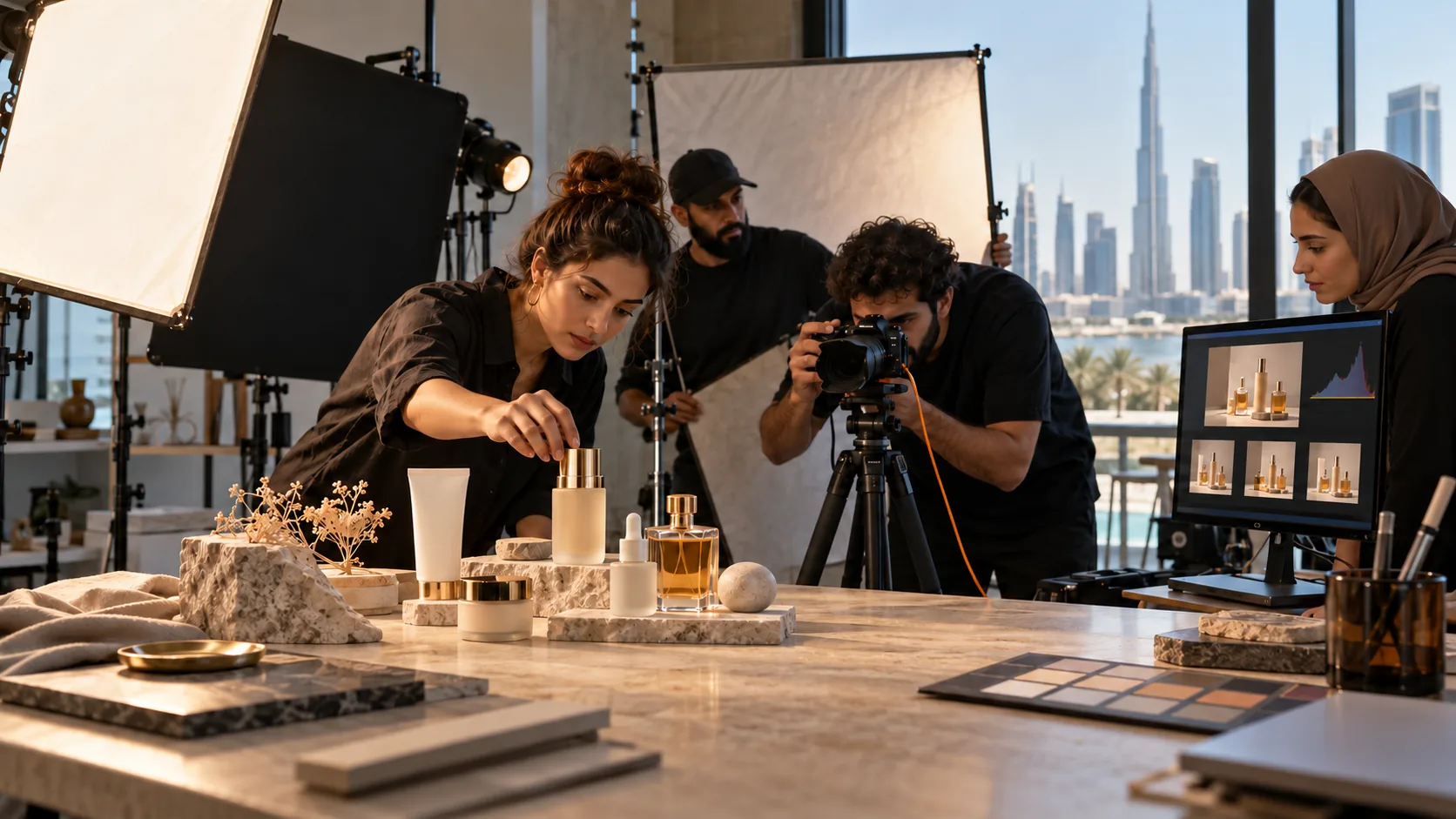
Product photography cost in Dubai can mean AED 75-250 for a simple edited packshot, roughly AED 1,000-4,000 for a defined studio session, or AED 6,000-30,000 and above for a commercial production with creative direction, sets, talent and broad usage. Those are planning signals from public offers reviewed in October 2026, not an official market average or 247 Agency pricing. The useful number depends on the image system you need, not merely the time a camera is active.
A low per-image quote may cover one product on white with standard retouching. A higher project fee may include concept development, art direction, prop sourcing, a stylist, models, location permits, colour-critical post-production, multiple aspect ratios and paid-ad rights. Both can be fair. They are not comparable until the products, shots, files, approvals and rights are written into one brief.
"Quick answer: price a product shoot in eight layers—brief and creative direction, SKU and shot count, studio or location, crew and equipment, styling and talent, post-production, deliverable formats, and usage rights. Ask every supplier to mark each layer as included, limited, optional or excluded."
How much does product photography cost in Dubai in 2026?
Public Dubai offers show several buying models. Interstellar Photography lists AED 150 per classic photo, AED 250 per premium photo and AED 1,200 per creative advertising photo, with separate charges for some edits and conditions. Sweet Home Studio publishes session packages from AED 1,000 plus VAT for a one-hour ecommerce shoot to AED 4,000 plus VAT for three hours, while models are extra. Videography.ae publishes catalogue work from AED 2,000 and says most of its product projects fall between AED 2,000 and AED 7,000. Sources: interstellar.photography/product-photography; sweethomestudio.ae/product; videography.ae/product-photography-dubai, reviewed 27 October 2026.
At the broader commercial end, ALM Media's published capability deck shows product photography at AED 6,000-30,000, with final pricing affected by usage duration and distribution. These figures describe different products, volumes and production standards. Treat them as dated examples that prove the spread, not as a universal Dubai benchmark. A quote becomes useful only when its unit and scope are visible.
| Buying unit | Works best when | Main comparison risk |
|---|---|---|
| Per final image | The shot type and retouching are repeatable | A cheap frame may exclude setup, minimum order, variants or advanced cleanup |
| Per product or SKU | Each item needs the same defined angles | Complex materials and grouped products may break the assumed throughput |
| Hourly or session | The list is small and the set stays stable | The clock can end before the required approved files exist |
| Half-day or day rate | A prepared catalogue can move efficiently through one set | Crew, studio, equipment, edits and overtime may sit outside the rate |
| Project fee | Lifestyle, campaign or launch work needs a complete outcome | The total is hard to compare unless deliverables, rights and exclusions are itemised |
| Monthly production | A brand has recurring launches or channel demand | Unused capacity, rollover rules and inconsistent SKU complexity can distort value |
If the brief also needs motion, compare the stills scope with the Dubai video production cost guide. Sharing a set, products and art direction can create efficiency, but only when the combined quote states which crew, lighting, edits and rights apply to each medium.
What changes a product photography quote most?
| Cost driver | Why it changes the work | What to put in the brief |
|---|---|---|
| SKU and variant count | Every colour, size, flavour or pack can require handling, matching and file naming | List every physical item and which variants share imagery |
| Angles per SKU | Front, back, detail, scale, packaging and in-use views multiply capture and retouching | Define mandatory and optional views by channel |
| Material difficulty | Glass, chrome, jewellery, liquids, fabric and screens need different lighting and cleanup | Send reference photos and identify reflective, translucent or moving parts |
| Creative style | White-background packshots are more repeatable than styled sets or campaign compositions | Separate catalogue, lifestyle and hero-shot concepts |
| Props and set build | Surfaces, food, flowers, furniture and custom fabrication add sourcing and reset time | Name who sources, approves, owns and disposes of each item |
| Talent | Models, hands, stylists and specialists add casting, schedules, releases and usage fees | State appearance, territory, channels and licence term |
| Post-production | Dust removal, compositing, colour matching, reflections and label repair vary sharply | Provide a retouching standard and approval examples |
| Outputs | Web, marketplace, social, print and outdoor need different crops, resolution and colour handling | List dimensions, ratios, formats, naming and delivery structure |
| Deadline | Rush work compresses booking, approvals and retouching | Set product-arrival, shoot, proof and final dates |
The strongest predictor is often not the number of products but the number of approved visual decisions. Fifty identical boxes on one white sweep can be more efficient than three cosmetic products that each need a liquid texture, reflective cap, styled surface and campaign composition. Ask providers to show the assumed throughput and the condition that would trigger a change order.
Which images do you actually need?
Start with the commercial job of each image. A marketplace main image helps a shopper identify the item. A product-detail image explains a feature or scale. A lifestyle image makes the product easier to imagine in use. A campaign image creates attention and carries a brand idea. Trying to make one frame do all four jobs usually produces a compromise.
| Asset type | Primary job | Typical specification questions |
|---|---|---|
| Catalogue packshot | Show the product accurately and consistently | Background, angle, crop, shadow, colour tolerance and file naming |
| Product-detail set | Answer objections about features, materials, size and contents | Macro details, packaging, scale references, components and sequence |
| Lifestyle image | Show context, audience and use | Location, props, hands or models, authenticity and releases |
| Campaign hero | Express positioning and stop attention | Concept, art direction, set build, copy-safe space and media rights |
| Social and ad variants | Fit channel placements and test creative hypotheses | 1:1, 4:5, 9:16, hooks, text-safe areas and iteration volume |
| Print or outdoor master | Hold detail at large physical sizes | Resolution, colour profile, bleed, retouching depth and final media plan |
Build the visual system through content production services when product stills must work with video, campaign assets and recurring social formats rather than live as an isolated shoot.
What marketplace requirements belong in the brief?
Write the destination before the shot list. Amazon UAE's current product image guide requires at least one compliant main image, accepts images from 500 to 10,000 pixels on the longest side, recommends 1,000 pixels or more for zoom, and requires the product to fill 85% of the main-image area on a pure white background. The main image must show the product accurately, without extra text, price details or marketplace badges. Source: Amazon Seller Central UAE, "Product image guide" (sellercentral.amazon.ae), reviewed 27 October 2026.
Do not turn one platform's rules into a permanent universal template. Marketplace and category requirements can change, and your own website may benefit from contextual or editorial imagery that a marketplace main slot rejects. Ask the supplier to map each file to a channel and requirement version, then keep an editable delivery index by SKU. Verify Noon, retailer and category rules directly in the relevant seller portal before production rather than relying on an old generic checklist.
Should you choose packshots, lifestyle photography or a campaign shoot?
| Approach | Best use | Trade-off |
|---|---|---|
| Packshots on white | Catalogues, marketplaces, comparison and operational consistency | Efficient and accurate, but rarely communicates a distinctive world |
| Simple styled stills | Website sections, organic social and product launches | Adds context without a full campaign, but prop consistency needs control |
| Lifestyle with talent | Demonstrating use, fit, scale and audience | More relatable, with added casting, release, location and schedule risk |
| Campaign production | Hero launches, paid media, print and brand-building | Highest creative control and asset value, but more pre-production and rights complexity |
| Hybrid capture | Brands needing catalogue accuracy and campaign variety together | Can share logistics, but the schedule must protect both throughput and creative quality |
Use the brand identity package guide to confirm colours, typography, art direction and application rules before an expensive shoot turns an unresolved identity into permanent assets.
Can AI or 3D replace a traditional product shoot?
Sometimes—but treat the choice as a fidelity and rights decision, not only a price comparison. Traditional capture is usually the clearest base when exact packaging, material, finish, fit or regulatory detail matters. 3D can be efficient for products that already have accurate models and need controlled angles or configurations. Generative AI can help explore backgrounds and produce variants, but labels, geometry, reflections and small product details require deliberate verification.
A defensible hybrid workflow starts with approved real reference capture, locks the product's non-negotiable details, records which elements are generated or composited, and assigns a human quality check against the physical item. The quote should state source-file ownership, model or platform restrictions, permitted media, revision treatment and who accepts the risk of inaccurate output. Do not present a synthetic product feature as factual.
How should Arabic-English product content be scoped in the UAE?
The camera file may be language-neutral, but the asset system is not. Arabic and English packaging versions, label orientation, ingredient panels, dimensions, promotion overlays and landing-page crops can require different shots or safe areas. Mixed-direction text is especially easy to damage during compositing. Include the exact physical packaging variants and final copy owner in the brief before capture.
Use the acceptance logic in the UAE Arabic-English website design guide so Arabic product pages receive the correct imagery, alt text, crop, file name and journey instead of inheriting English assets by default.
Which permits, releases and usage rights should the quote cover?
A controlled studio packshot does not create the same permissions burden as a campaign in a public or managed location. The Dubai Film and TV Commission says production, broadcasting and photography activities are eligible for filming permits; its FAQ lists personal use, weddings, events, educational purposes and press conferences among scenarios that do not require a filming permit. DFTC also states that approval is subject to location-owner permission. Confirm the current route for the exact activity and location before the shoot. Sources: filmdubai.gov.ae/s/faq and filmdubai.gov.ae/s/terms-and-condition, reviewed 27 October 2026.
The UAE Government identifies photographic works as protected under Federal Decree-Law No. 38 of 2021. Article 45 also addresses permission around publishing photographs of people. Your agreement should therefore state who owns the commissioned files, which usage rights are licensed, the territory and duration, whether paid advertising and out-of-home are included, and whether models, locations, props, music or third-party artwork have separate restrictions. Source: u.ae/en/information-and-services/business/intellectual-property and the linked federal copyright law, reviewed 27 October 2026. This is a procurement checklist, not legal advice.
What should a complete product photography quote include?
- Business objective, audience, channels and measurable acceptance criteria
- SKU list, variants, product dimensions and condition on arrival
- Shot list with angle, composition, background and required output for each item
- Creative direction, references, moodboard and named approval owner
- Studio or location, dates, access, permits, transport, storage and insurance responsibilities
- Crew, camera and lighting level, stylist, props, set build, models and releases
- Proofing method, on-set approval and policy for reshoots caused by changed products or briefs
- Retouching depth, colour reference, compositing rules and number of revision rounds
- Exact final files, crops, resolutions, formats, colour spaces, names and folder structure
- Usage rights, territory, channels, term, paid media, print, outdoor and third-party restrictions
- Source or layered files, archive period, backup and handover terms
- Fee, VAT, deposits, overtime, rush work, expenses, cancellation and change-order rules
The UAE Federal Tax Authority states that the standard VAT rate is 5%. Ask whether each published or quoted figure includes VAT and how pass-through costs such as talent, props, locations and couriers are invoiced. Source: UAE Federal Tax Authority, "What is the standard rate of VAT in the UAE?" (tax.gov.ae), reviewed 27 October 2026.
Freelancer, studio or integrated agency: which model fits?
| Provider model | Best fit | Main risk to manage |
|---|---|---|
| Freelance photographer | Small, well-defined shoots with one visual specialist | Capacity, backup, art direction and post-production depth may depend on one person |
| Product photography studio | Repeatable catalogue, ecommerce and specialist material work | The standard package may not cover campaign strategy or multi-channel adaptation |
| Production company | Complex sets, talent, locations and large crews | A capable production can be excessive if the real need is operational catalogue volume |
| Integrated creative agency | Stills must connect to brand, web, social, ads and a campaign system | A broad retainer can hide the exact photographer, production standard or deliverable count |
| In-house setup | High recurring volume with stable products and visual rules | Equipment is easier to buy than lighting, styling, colour and quality-control discipline |
For recurring social demand, compare the production line with the social media management cost guide. Photography, channel management and paid distribution are separate cost layers even when one partner provides all three.
How do you compare two product photography proposals fairly?
Give every provider the same product manifest, shot matrix, references, channels, dates and rights requirement. Then score the written response, not the most attractive portfolio image. A jewellery portfolio does not prove high-volume fashion throughput, and a clean catalogue does not prove campaign art direction. Ask for evidence from products with similar material, volume and destination.
| Evaluation area | Weight | What earns full marks |
|---|---|---|
| Scope clarity | 20% | Every SKU, angle, final file, revision, dependency and exclusion is countable |
| Relevant craft | 20% | Comparable materials and styles show controlled lighting, colour and retouching |
| Production plan | 15% | Products, props, talent, locations, schedule, permits and backup are owned |
| Channel fitness | 15% | Marketplace, website, social, paid and print outputs have explicit specifications |
| Rights and ownership | 10% | Media, territory, duration, source files and third-party restrictions are clear |
| Quality control | 10% | Proofing, colour reference, naming, approvals, reshoots and acceptance are defined |
| Commercial fit | 10% | Fee, tax, expenses, overtime, rush, cancellation and change rules are visible |
What should happen before, during and after the shoot?
Before: lock the manifest, shot matrix and decision path
Inspect products, confirm packaging versions, group repeatable setups, approve the moodboard, test difficult materials and identify the person who can approve frames. Record marketplace rules, crop-safe areas and rights at the same time. A pre-production call cannot replace a signed shot matrix.
During: approve representative frames before volume capture
Use tethered review where possible. Approve one representative frame for each setup, material and crop family before the team repeats it across products. Track completed shots against the manifest, quarantine damaged or incorrect products and record intentional deviations rather than discovering them in retouching.
After: verify accuracy, delivery and deployability
Check colour and label accuracy against the physical item, review edges and reflections at full size, test naming against the catalogue, open every required format and place sample files in the real marketplace, website and ad templates. Accept the job against the delivery index, not a gallery link alone.
Red flags in a product photography quote
- One price with no SKU, angle, final-file or retouching count
- Unlimited photos or edits without a defined session, approval flow or capacity
- A portfolio that does not show comparable product materials or channel requirements
- No distinction between proofs, selects, edited finals and source files
- Models, props, locations or permits described as included but not budgeted or owned
- Paid-ad, print or GCC usage assumed without a written licence
- Marketplace compliance promised without naming the current platform rule set
- AI-generated product details accepted without comparison to the physical item
- No reshoot rule when the wrong packaging, damaged sample or changed brief arrives
- A very low per-image rate that hides minimum orders, setup, advanced cleanup, rush or VAT
Need one brief for product stills, video and campaign assets?
247 Agency can connect product photography requirements with brand direction, ecommerce pages, social formats, paid creative and a clear UAE production plan.
Discuss your content briefThe bottom line
Product photography cost in Dubai is useful only when the quote names the visual system being purchased. Separate repeatable packshots from styled and campaign work; count products, angles and files; make talent, permits, retouching and rights visible; and map every output to a real channel. The cheapest frame can become expensive when it cannot be listed, cropped, licensed or matched across a catalogue.
Buy the smallest production model that can accurately represent the product and reliably deliver the required asset set. A disciplined brief gives photographers a fair basis for pricing, protects the shoot day from avoidable decisions and leaves the business with files it can identify, govern and use—not just images that look impressive in a gallery.
Author
Valeriia Yahnenko
CEO & Co-Founder, 247 Agency
Valeriia Yahnenko is the co-founder and CEO of 247 Agency, a full-service digital marketing agency based in Dubai. She works with businesses across the UAE and Europe on brand positioning, paid media, social media strategy, website development and Google Ads — building systems that generate measurable reach, leads and sales rather than isolated campaigns.
LinkedIn Profile →Frequently Asked Questions
How much does product photography cost in Dubai?
Public offers reviewed in October 2026 show simple edited packshots around AED 75-250 per image, defined studio sessions around AED 1,000-4,000, and broader commercial projects from roughly AED 6,000-30,000 or more. These are planning signals, not an official average. SKU count, materials, angles, sets, talent, retouching, outputs and rights determine the comparable price.
Is product photography priced per image or per day?
Both models are common. Per-image or per-SKU pricing suits repeatable catalogue work; session or day rates suit prepared volume; project fees suit lifestyle and campaign work. Compare the number of approved finals, setup, crew, studio, retouching, rights, overtime and exclusions—not the pricing unit alone.
What should a Dubai product photography quote include?
It should list products and variants, angles, styling, studio or location, crew, equipment level, props, talent, permits, proofs, retouching, revisions, exact file formats and crops, naming, deadline, usage rights, source-file terms, VAT, expenses, overtime, cancellation and change-order rules.
Do product photos for Amazon UAE need a white background?
Amazon UAE's current guide requires a pure white background for the main product image and says the product should fill 85% of the image area. Other images can serve different explanatory roles within the platform's rules. Verify the current category and marketplace requirements before each shoot.
Can AI-generated images replace product photography?
They can support background exploration and variant production when the physical product is accurately represented and every output is checked. Traditional capture remains the safer base where packaging, material, fit, colour or regulatory detail must be exact. The contract should clarify source assets, rights, restrictions and responsibility for inaccuracies.