WhatsApp Marketing for UAE Businesses: The 2026 Strategy Guide
Email gets opened 22% of the time. WhatsApp gets opened 98% of the time. In a country where nearly everyone uses WhatsApp every day, businesses that treat it as a broadcast tool are leaving most of its value on the table.
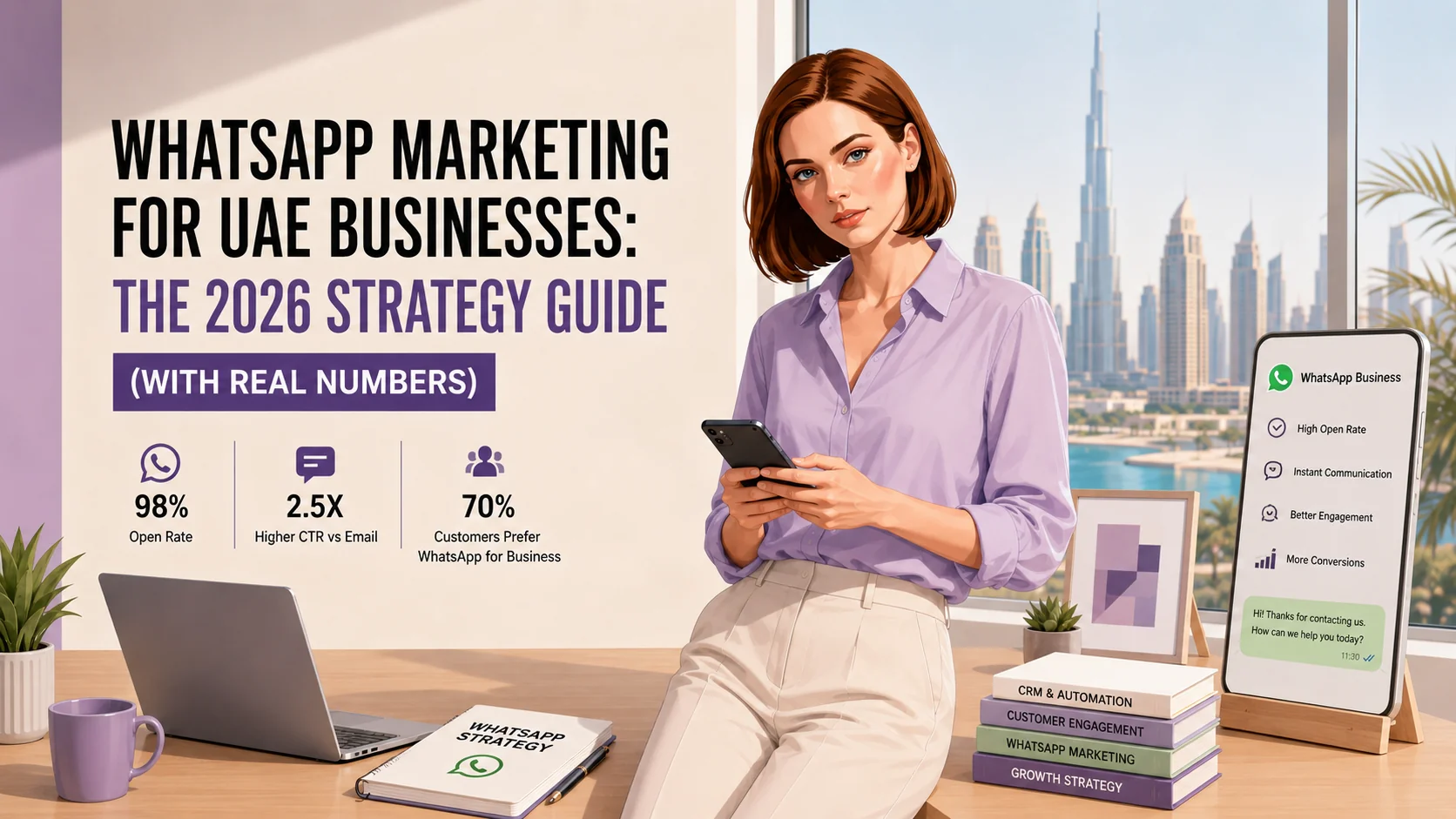
Email gets opened 22% of the time on a good day. WhatsApp gets opened 98% of the time. In a country where nearly every smartphone user checks WhatsApp multiple times daily, that difference isn't a small edge — it's a completely different category of marketing channel.
WhatsApp penetration in the UAE sits above 90% among smartphone users, making it one of the highest adoption rates in the world. For businesses in Dubai and across the UAE, this isn't a social media platform to consider alongside Instagram or LinkedIn. It's the primary communication channel for a significant portion of the population — used for personal conversations, business enquiries, customer service, and increasingly, purchasing decisions.
The problem is that most UAE businesses treat WhatsApp like a broadcast tool. They collect a list of numbers, send a bulk promotional message, and measure success by whether anyone replied. That approach is ineffective, often non-compliant, and misses what makes WhatsApp genuinely powerful for business in this market.
"WhatsApp's real value isn't reach — it's proximity. A message that arrives in the same app where someone talks to their family is treated very differently from an ad or an email."
Why WhatsApp works differently in the UAE than anywhere else
The UAE is not a typical WhatsApp market. Yes, WhatsApp has over 2 billion users globally, but in most markets it competes with iMessage, local messaging apps, and SMS. In the UAE, WhatsApp is the default. It replaces email for many informal business conversations, replaces phone calls for most customer service interactions, and sits at the centre of how families and communities communicate.
This changes what's possible. In markets where WhatsApp is just one of several messaging options, a business message in WhatsApp might feel like an intrusion. In the UAE, where WhatsApp is already where business happens, a well-timed, relevant message feels like a natural next step — especially when someone has already visited your website, clicked your ad, or expressed interest in your service.
The implication for businesses is significant: WhatsApp isn't just a customer service tool in the UAE context. Used correctly, it's a complete lead generation and nurturing channel.
The three tiers of WhatsApp marketing: which one fits your business
Most guides treat WhatsApp marketing as a single thing. It isn't. There are three structurally different approaches, each with different capabilities, costs, and appropriate use cases. Understanding which tier fits where you are right now saves significant time and money.
Tier 1: WhatsApp Business App (free)
The WhatsApp Business App is the free version designed for small businesses. It adds a business profile (name, description, hours, website, address), quick replies for common questions, a product catalogue, and basic automated messages (a welcome message, an away message). It works from a single phone with one logged-in number.
It's appropriate for businesses with under 500 active contacts, relatively low enquiry volume, and a single person managing communications. The main limitation: you can't send proactive marketing messages to new contacts without them messaging you first, and it doesn't integrate with CRM systems or automate sequences.
Tier 2: WhatsApp Business API via a Business Solution Provider (BSP)
The WhatsApp Business API is what you need when you want to send proactive messages, automate sequences, integrate with a CRM, manage multiple team members on one number, or handle high volumes of conversations. You access the API through a Meta-certified Business Solution Provider (BSP) — companies like WATI, AiSensy, Interakt, or 360dialog.
The BSP layer adds a user interface (so you don't need to build your own), conversation management tools, chatbot flows, and analytics. You pay the BSP a monthly platform fee plus message costs. BSP fees in the UAE market typically start at around AED 350–900/month for small business plans.
Tier 3: Click-to-WhatsApp Ads
Click-to-WhatsApp Ads are Meta paid ads where clicking the ad immediately opens a WhatsApp conversation with your business — no landing page required. The user sees the ad on Instagram or Facebook, taps it, and a WhatsApp chat opens with a pre-filled message. From that point, the conversation happens in WhatsApp.
This is where the most significant performance marketing opportunity sits for UAE businesses right now. The friction is extremely low: no form to fill, no page to load, no email address to share. You tap, you chat. For high-intent service enquiries — clinics, real estate, professional services, education — this format can dramatically outperform traditional landing page campaigns.
Click-to-WhatsApp Ads: the performance channel most UAE businesses are missing
Click-to-WhatsApp Ads have been available in Meta for several years, but many UAE advertisers have been slow to adopt them as a primary performance channel. The hesitation usually comes from one concern: 'If someone opens WhatsApp, we have to be ready to respond immediately.' That's true — but it's also exactly why they convert so well.
When someone clicks a Meta ad and lands on a webpage, they're deciding whether to trust the page enough to fill in a form and wait for a callback. When they click a Click-to-WhatsApp ad, they're already in a conversation. The psychological commitment is higher, the friction is lower, and the lead quality tends to be better because the person has self-selected into a direct communication channel.
Meta's own data across markets shows Click-to-WhatsApp campaigns achieving conversion rates significantly above traditional lead form campaigns in service-based industries. In the UAE context, where WhatsApp is the preferred communication channel, the advantage is even more pronounced.
- Setup: create a campaign in Meta Ads Manager and select 'Engagement' or 'Leads' as the objective, then choose WhatsApp as the messaging destination
- Pre-filled message: set a default opening message that appears when someone first opens the chat — e.g. 'Hi, I saw your ad and I'd like to know more about your services'
- Response speed: the biggest factor in conversion rate — businesses that respond within 5 minutes of a WhatsApp enquiry convert at far higher rates than those that respond hours later
- Recommended starting budget for UAE: AED 3,000–6,000/month to generate meaningful data across 3–4 weeks
- Best-performing industries in UAE: real estate, clinics and healthcare, education and training, professional services, home services
WhatsApp Business API pricing: what changed in 2025
Meta significantly changed the WhatsApp Business API pricing model in 2025. Understanding the new structure matters because it affects the cost calculation for any campaign involving proactive outbound messaging.
The previous model charged per 24-hour conversation window — you paid once per user session regardless of how many messages were exchanged. The 2025 model moved to per-message pricing for marketing messages, which changes the economics for broadcast-style campaigns.
Under the current pricing for the Middle East and Africa region, marketing messages (proactive messages sent to customers outside of an active conversation) cost approximately USD 0.041–0.046 per message (around AED 0.15–0.17). Utility messages — confirmations, appointment reminders, order updates — cost significantly less at around USD 0.011–0.016 per message (AED 0.04–0.06).
"The practical impact: sending a marketing message to 1,000 contacts costs approximately AED 150–170 in message fees, plus the BSP platform fee. For a campaign that generates even 20 qualified enquiries from 1,000 messages, the CPL is AED 8–9 in message costs — before factoring in the time cost of managing responses."
One important rule: you can only send proactive marketing messages to contacts who have opted in. A contact who messages your business first opens a 24-hour service window during which you can reply freely at no cost. Only outbound initiation of a new marketing conversation triggers the per-message rate.
Building a WhatsApp lead nurture system that actually converts
The difference between businesses that see strong results from WhatsApp and those that don't usually comes down to what happens after the first message. Most businesses respond to initial enquiries, send a price list, and then either get ignored or lose the lead. Businesses with a structured nurture system convert a much higher percentage of initial contacts into qualified conversations.
A basic WhatsApp nurture system for a UAE service business has four components:
1. An automated welcome message
Set up via the WhatsApp Business App or your BSP: when someone messages you for the first time, they get an immediate reply acknowledging the message and setting a response time expectation. "Thank you for reaching out to [Business Name]. Our team will get back to you within 1 hour during business hours (Mon–Fri, 9am–6pm UAE time)." This manages expectations and signals that the business is professional and responsive.
2. A qualification sequence
A chatbot flow (or a trained team member following a script) that asks 2–3 qualifying questions: what service they're interested in, what their timeline is, and roughly what they're looking to spend. This separates serious prospects from tyre-kickers early, so your team's time is spent on conversations with real buying intent.
3. A follow-up sequence for non-responders
Many initial enquiries don't convert in the first conversation — they get busy, they're comparing options, or they weren't ready to move immediately. A structured follow-up sequence (a check-in message 48 hours later, a value-add message 5 days later, a final follow-up at 14 days) recovers a meaningful percentage of these leads without requiring manual tracking.
4. Broadcast messages to past contacts
Contacts who opted in but didn't convert can receive periodic broadcast messages: a relevant article, a seasonal promotion, a case study from a similar client. These shouldn't be more than once or twice a month — frequency that makes sense in an email context is too high for WhatsApp, where it feels intrusive.
UAE legal compliance: what you must know before you send
WhatsApp marketing in the UAE operates under two layers of compliance: Meta's own WhatsApp Business Policy and the UAE's Federal Decree-Law No. 45 of 2021 on the Protection of Personal Data (PDPL).
The most important requirement from both: explicit opt-in consent. You must have documented evidence that a contact agreed to receive marketing messages from your business on WhatsApp before you send them a proactive marketing message. A person messaging your business first counts as implied consent for service messages. For proactive marketing messages, you need explicit opt-in — typically a checkbox on a form, a verbal confirmation recorded in your CRM, or an opt-in via a WhatsApp message that the user initiates themselves.
What you must not do: buy phone number lists and send unsolicited WhatsApp messages, use third-party bulk-blast tools that bypass the WhatsApp Business API (these violate Meta's terms and will get your number banned), or send marketing messages without an opt-out mechanism.
Every marketing message must include a way for the recipient to opt out — typically a "Reply STOP to unsubscribe" instruction. Once someone opts out, they must be removed from your marketing lists immediately.
Benchmarks: what to actually expect from WhatsApp marketing in the UAE
Setting realistic expectations matters because WhatsApp marketing can be measured on very different metrics depending on whether you're running Click-to-WhatsApp paid campaigns or outbound API-based broadcasts.
- Message open rate: 90–98% (vs email average of 22–28%) — this is the most cited WhatsApp advantage and it's real
- Response rate to well-targeted broadcast messages: 15–35% (vs email reply rates of 2–5%)
- Click-to-WhatsApp ad conversion to conversation: typically 3–8x higher than equivalent landing page campaigns for service businesses in the UAE
- Chatbot qualification conversion (leads that become qualified after a chatbot flow): 20–30% for well-designed flows, 5–10% for poorly designed ones
- Time-to-response impact on conversion: businesses responding within 5 minutes convert WhatsApp enquiries at 3–4x the rate of businesses responding after 2 hours
- Opt-out rate for compliant broadcast campaigns: 1–3% per send (higher if content is irrelevant, lower if highly targeted)
Your 30-day WhatsApp marketing launch plan
If you're starting from zero, here's a realistic timeline for getting WhatsApp marketing operational for a UAE service business:
- Week 1: Set up WhatsApp Business App properly — complete business profile, set up welcome and away messages, create 5–10 quick replies for your most common enquiries, add a product/service catalogue if relevant
- Week 2: Add a WhatsApp click-to-chat button to your website (particularly the homepage and contact page), ensure it's visible above the fold on mobile, set up a pre-filled opening message
- Week 3: If volume warrants it, evaluate a BSP (WATI, AiSensy, or 360dialog all have UAE-compatible setups) — set up a basic qualification chatbot flow for new contacts
- Week 4: Launch your first Click-to-WhatsApp campaign on Meta Ads with a budget of AED 3,000–5,000, targeting your ideal customer profile in Dubai or the relevant UAE emirate, with a direct response creative and a clear CTA
- Ongoing: track response time, conversation-to-lead conversion rate, and lead-to-client rate — these three numbers tell you where the system needs improvement
Want help building a WhatsApp lead system for your UAE business?
247 Agency sets up and manages Click-to-WhatsApp campaigns and WhatsApp lead nurture systems for businesses across the UAE. We handle the ad creative, chatbot flows, and follow-up sequences.
Let's talk about WhatsApp marketingThe bottom line
WhatsApp isn't a nice-to-have in the UAE market — it's the channel where a significant portion of business decisions get made. Businesses that treat it seriously, build a proper system around it, and use it compliantly tend to see cost per lead figures that are substantially lower than equivalent paid search or social campaigns.
The businesses that don't see results from WhatsApp are usually doing one of three things: sending bulk messages without proper consent (which gets accounts banned), responding too slowly to initial enquiries (which loses leads to faster competitors), or treating it as a broadcast tool rather than a conversation channel. Fix those three things, and WhatsApp becomes one of the most cost-effective marketing channels available to a UAE business.
Author
Valeriia Yahnenko
CEO & Co-Founder, 247 Agency
Valeriia Yahnenko is the co-founder and CEO of 247 Agency, a full-service digital marketing agency based in Dubai. She works with businesses across the UAE and Europe on brand positioning, paid media, social media strategy, website development and Google Ads — building systems that generate measurable reach, leads and sales rather than isolated campaigns.
LinkedIn Profile →Frequently Asked Questions
Is WhatsApp marketing legal in the UAE?
Yes, WhatsApp marketing is legal in the UAE when done correctly. You need explicit opt-in consent from contacts before sending proactive marketing messages, under both Meta's WhatsApp Business Policy and the UAE's Federal Decree-Law No. 45 of 2021 (PDPL). Every marketing message must include an opt-out option. Using third-party bulk-blast tools that bypass the WhatsApp Business API violates Meta's terms and can result in your number being permanently banned.
What is the difference between WhatsApp Business App and the WhatsApp Business API?
The WhatsApp Business App is free, works from a single phone, and suits businesses with low volume and a small contact list. The WhatsApp Business API (accessed through a Business Solution Provider like WATI or AiSensy) enables automation, multi-agent access from a shared inbox, CRM integration, chatbot flows, and proactive outbound messaging to opted-in contacts. The API is what you need once your business handles more than a few dozen conversations per week or wants to run WhatsApp as a scalable marketing channel.
How much do Click-to-WhatsApp ads cost in the UAE?
Click-to-WhatsApp ad costs in the UAE are similar to standard Meta Ads costs for the region. Expect CPCs of AED 2–8 for most service categories, with cost per WhatsApp conversation opened typically running AED 5–20 depending on audience targeting and creative quality. Cost per qualified lead (someone who opens a conversation and expresses genuine interest) varies by industry but often runs AED 40–150 for well-optimised campaigns in professional service categories.
How quickly should I respond to WhatsApp enquiries?
Responding within 5 minutes dramatically improves conversion rates — businesses that respond within 5 minutes of an initial WhatsApp enquiry convert significantly more leads than those that take 30 minutes or more. In the UAE market specifically, buyers are often contacting multiple providers simultaneously. The business that responds first, intelligently, and with a clear next step wins the conversation. If you can't guarantee fast response times, set up an automated welcome message that acknowledges the enquiry and sets a response time expectation.
What is the open rate for WhatsApp messages?
WhatsApp messages have an open rate of 90–98%, compared to email open rates of 22–28% for marketing emails. This is the most significant advantage of WhatsApp as a communication channel. However, a high open rate only translates to business results if the message content is relevant, timely, and provides a clear value or call to action. Open rate without engagement or conversion is just a vanity metric.