Website Traffic but No Leads: 11 Reasons It Happens and How to Fix It
If your website gets traffic but not enough leads, the problem is usually not just traffic. It is often a mix of weak intent, weak messaging, weak trust, weak conversion flow, or weak follow-up after the click.
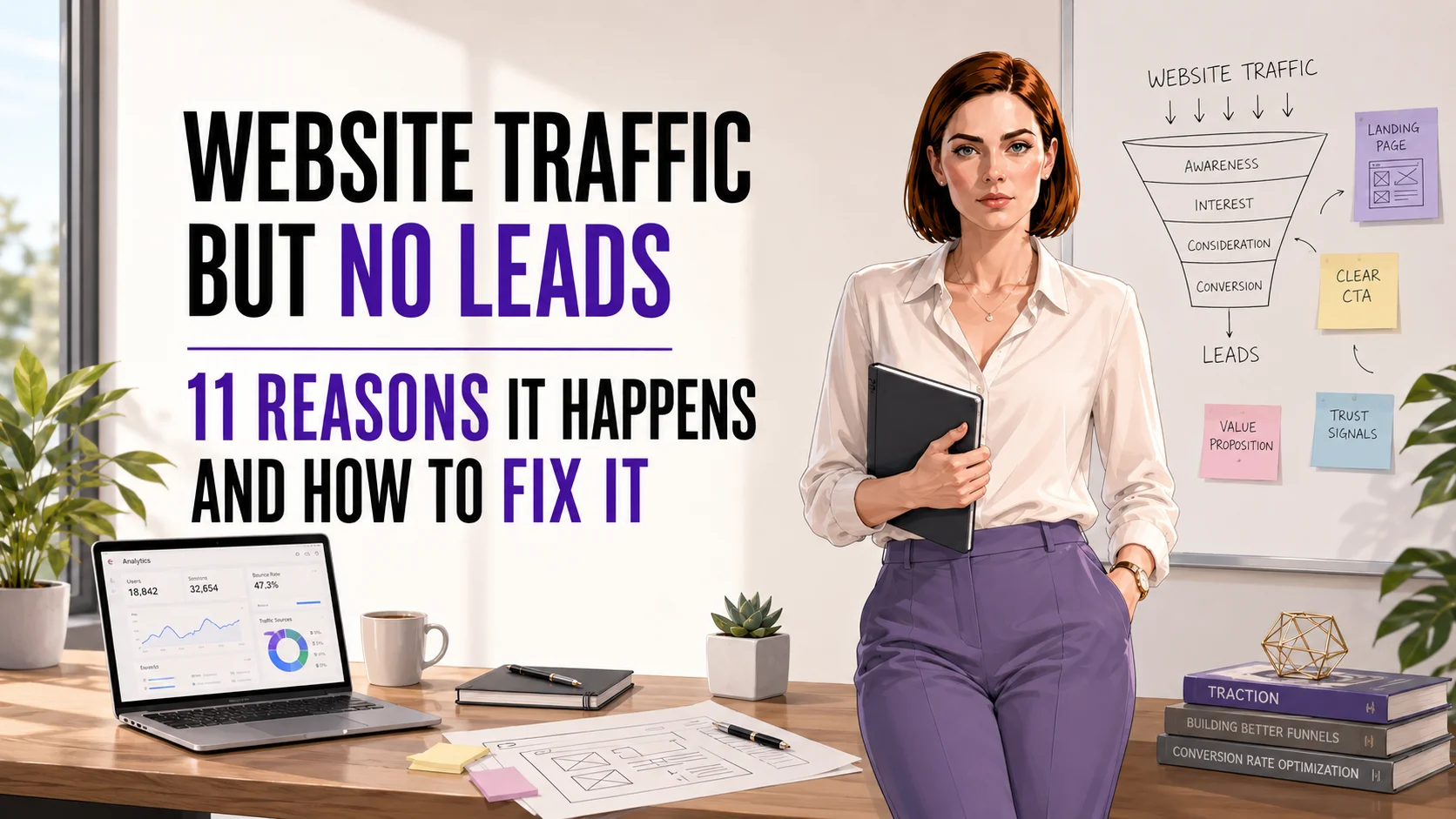
Few marketing problems are more frustrating than this one: your website is getting traffic, but hardly anyone is turning into a lead.
At first, it can feel confusing. The SEO report looks active. The ads are generating clicks. Search Console impressions are rising. Analytics shows users landing on the site. On paper, movement exists. But commercially, nothing really changes.
That usually means one thing. The problem is not just traffic. It is what happens before, during, and after the visit.
"Traffic is only useful when it reaches the right people, lands on the right page, builds enough trust, and makes the next step feel worth taking."
Quick answer
If your website gets traffic but no leads, the issue usually falls into one of three buckets:
- The traffic is not as qualified as it looks.
- The page does not convert qualified visitors well enough.
- The business is losing opportunities after the click or after the form.
Most websites that struggle with leads have leaks in more than one bucket at the same time.
Before you fix anything, diagnose the problem correctly
A lot of companies jump to the wrong conclusion. If traffic is up, they assume the website must be fine and the problem is sales. If leads are low, they assume they need more traffic. Both can be wrong.
The better question is this: are the right people arriving, and when they arrive, does the website help them move toward a decision?
That is why this issue should always be reviewed as a chain, not as one metric:
- Traffic source
- Search or campaign intent
- Landing page relevance
- Offer clarity
- Trust level
- CTA strength
- Form or contact friction
- Lead handling speed
Once you look at the full chain, the reasons become much easier to spot.
1. The traffic looks good, but the intent is weak
This is one of the most common reasons. A site can attract traffic that is real, but not commercially useful.
Maybe the page ranks for broad informational keywords. Maybe the ad targeting is too loose. Maybe social traffic comes from people who are curious, not ready to enquire. Maybe the content attracts students, researchers, or competitors instead of buyers.
Traffic volume can make this look healthier than it is. But impressions and sessions are not the same thing as buyer intent.
How to fix it
- Review which queries and pages drive the traffic.
- Separate awareness traffic from decision-stage traffic.
- Tighten paid targeting if campaign traffic feels too broad.
- Publish more decision-support content, not only top-of-funnel content.
2. Your page does not make the offer clear fast enough
A lot of websites ask the visitor to figure things out alone. The design is polished, but the actual offer remains fuzzy. The visitor sees a stylish hero section, a vague promise, and a lot of brand language that sounds premium without saying anything concrete.
When people arrive with intent, they do not want a puzzle. They want clarity.
How to fix it
- State clearly what you do, who it is for, and what outcome you help create.
- Use a sharper headline and subheadline above the fold.
- Replace vague language with real commercial language.
- Check whether the first screen answers the visitor's core question in seconds.
If the website is polished but still commercially weak, it is often the same problem covered in Why Most Business Websites in the UAE Look Good but Convert Poorly.
3. The offer itself is not compelling enough
Sometimes the traffic is fine and the page is readable, but the offer is too soft. The website asks the user to enquire without giving a strong reason to do it now.
This happens when the service sounds generic, the package is unclear, the promise is weak, or the business never defines why it is a better choice than the alternatives.
People do not become leads just because they understand your service. They become leads when they feel there is a meaningful reason to take the next step.
How to fix it
- Strengthen the commercial angle of the offer.
- Show what is included, what changes, and what result is realistic.
- Add specificity around process, scope, or ideal fit.
- Reduce generic positioning and improve differentiation.
4. The CTA is too soft, too early, or too confusing
A lot of websites technically have calls to action, but they are weak in practice. Buttons say things like learn more, explore, discover, or start now without clearly telling the user what happens next.
In other cases, the CTA appears before the visitor has enough trust to act. Or the page includes too many competing actions, so the visitor never knows which one matters most.
How to fix it
- Use one clear primary CTA per page.
- Make the next step specific, such as book a strategy call or request a proposal.
- Place the CTA where clarity and trust have already been built.
- Remove unnecessary competing buttons and distractions.
5. The website does not create enough trust
This is a bigger issue than many teams admit. Visitors often do not convert because the site feels risky, not because the service is irrelevant.
If the page asks for a call, form submission, or demo request without proving credibility first, users hesitate. That hesitation kills a lot of conversion quietly.
Trust is rarely built by design alone. It is built by evidence.
How to fix it
- Add case studies, testimonials, recognizable clients, or proof of delivery.
- Show a clear process so the next step feels safer.
- Add founder, team, or company credibility where relevant.
- Place proof before the main contact ask, not after it.
6. The form or contact flow creates friction
Some websites lose leads simply because the form experience is annoying. Too many fields. Too many steps. Weak mobile usability. Unclear labels. Forced account creation. No reassurance about what happens after submission.
Every bit of friction matters more when the intent is moderate rather than urgent. Small annoyances become reasons not to enquire.
How to fix it
- Shorten the form to the information you actually need.
- Make buttons and fields easy to use on mobile.
- Set clear expectations about response time and next steps.
- Test the full contact flow yourself, not only the form design.
7. The mobile experience is hurting conversion
A website can work reasonably well on desktop and still fail badly on phones. That matters because a large share of modern traffic arrives on mobile first, even in serious B2B and service categories.
If the page is slow, awkward, visually cramped, or hard to tap through, a lot of intent disappears before the user even reaches the form.
Mobile conversion problems often hide behind decent desktop reviews and nice-looking mockups.
How to fix it
- Test your main landing pages on real phones, not only browser preview mode.
- Check button placement, form usability, text density, and speed.
- Reduce heavy visual elements that add friction but not value.
- Make the contact action visible without excessive scrolling.
8. The content attracts readers, but not buyers
This is especially common on content-led websites. Traffic comes in because the content is interesting, but the page never helps the reader move from curiosity to decision.
An article can attract thousands of visits and still produce almost no leads if the topic has weak commercial intent or the article never bridges into a next step.
This does not mean awareness content is useless. It means you need decision-stage content in the system too.
How to fix it
- Create more content around buying questions, comparisons, pricing, and mistakes to avoid.
- Connect informative articles to relevant service pages and proof.
- Use CTAs that fit the stage of intent instead of forcing a hard sell everywhere.
- Review which articles bring traffic but no meaningful commercial movement.
This is also why content built for Google, ChatGPT, and AI search should still be tied to real commercial questions, not just broad visibility.
9. You are measuring the wrong things
A website can look healthy in analytics and still be commercially weak. Teams often focus on sessions, bounce rate, average time on page, or low-level engagement without checking what really matters: qualified enquiries, call bookings, proposal requests, demo requests, and revenue influence.
If you do not measure the right conversion path, it becomes easy to celebrate movement that has no business value.
How to fix it
- Track the full path from visit to lead to qualified opportunity.
- Separate micro-conversions from real lead goals.
- Look at page-level conversion behavior, not only site-wide traffic charts.
- Review whether the pages getting the most traffic are also the pages closest to revenue.
10. Leads are being lost after the website does its job
Sometimes the website is not the main problem at all. The page generates enough interest, but the business responds too slowly, follows up weakly, or never qualifies leads well enough.
This creates a dangerous illusion. Marketing looks ineffective because closed business stays low, when the real leak is operational.
Websites do not convert in isolation. They hand off to people, workflows, and sales logic.
How to fix it
- Audit response time after form submissions or inbound calls.
- Improve lead qualification and routing.
- Check whether high-intent leads get a stronger follow-up sequence.
- Create feedback loops between sales and marketing.
11. Your traffic, page, and follow-up are not working as one system
This is the final reason because it is often the deepest one. The website is treated as one project. SEO is another. Paid ads are another. CRM is somewhere else. Sales follow-up lives in a different conversation. No one owns the full demand path.
When those pieces are disconnected, the website may get traffic but still fail to produce leads because nobody is building a coherent commercial experience from first click to final conversation.
"A high-converting website is not just a page with a form. It is one layer inside a full growth system."
How to fix it
- Align acquisition, website messaging, trust, lead capture, and follow-up.
- Review landing pages alongside campaign promise and audience intent.
- Treat website conversion as a commercial system, not a design task only.
- Make one team or owner responsible for the full path.
What to fix first this week
If you want a practical starting point, do not redesign the whole site immediately. Start with the highest-signal fixes:
- Review the top five pages bringing traffic right now.
- Check whether each page has a clear offer and clear CTA.
- Add trust proof near the main action point.
- Test the form and mobile experience yourself.
- Look at lead response time for the last ten enquiries.
- Compare traffic source quality, not just traffic volume.
These six checks usually reveal more than another month of guessing.
If the traffic mainly comes from paid media, also review why paid ads fail because many so-called ad problems are really landing-page and offer problems.
Getting traffic but not enough leads?
247 Agency helps businesses diagnose whether the leak is traffic quality, website clarity, trust, conversion flow, or lead handling and then fix the right layer instead of guessing.
Book a strategy callFinal takeaway
If your website gets traffic but no leads, more traffic is not automatically the answer.
The answer is usually better diagnosis. Sometimes the wrong people are visiting. Sometimes the right people are visiting, but the page is unclear. Sometimes the page is fine, but trust is weak or follow-up is slow.
Once you stop treating traffic as the goal and start treating qualified action as the goal, the real fixes become easier to see.
Author
Valeriia Yahnenko
CEO & Co-Founder, 247 Agency
Valeriia Yahnenko is the co-founder and CEO of 247 Agency, a full-service digital marketing agency based in Dubai. She works with businesses across the UAE and Europe on brand positioning, paid media, social media strategy, website development and Google Ads — building systems that generate measurable reach, leads and sales rather than isolated campaigns.
LinkedIn Profile →Frequently Asked Questions
Why is my website getting traffic but no leads?
Usually because one or more parts of the conversion path are weak: traffic intent, offer clarity, trust, CTA strength, form usability, or follow-up after the visit.
Can a website have good SEO but poor lead generation?
Yes. SEO can increase visibility and traffic without improving conversion. A page can rank and still underperform if the visitors are weakly qualified or the page does not turn attention into action.
What matters more: more traffic or better conversion?
It depends on the bottleneck, but many businesses try to solve a conversion problem with more traffic. If qualified visitors already arrive, improving conversion often creates a better return than simply buying or attracting more clicks.
How do I know whether the problem is traffic quality or the page itself?
Look at source intent, landing page behavior, CTA performance, and lead quality together. If the page gets highly relevant visitors and still converts poorly, the website or offer is more likely the issue. If traffic is broad or informational, the intent may be weak from the start.
Should I redesign the whole website if leads are low?
Not immediately. In many cases, sharper messaging, stronger trust proof, clearer CTAs, cleaner forms, and better lead handling improve results faster than a full redesign.