Google Ads vs Meta Ads in Dubai: Which Platform Delivers Better ROI for UAE Businesses?
The question isn't which platform is better. The question is which one is right for what your business is trying to do right now — and at what budget they start to make sense.
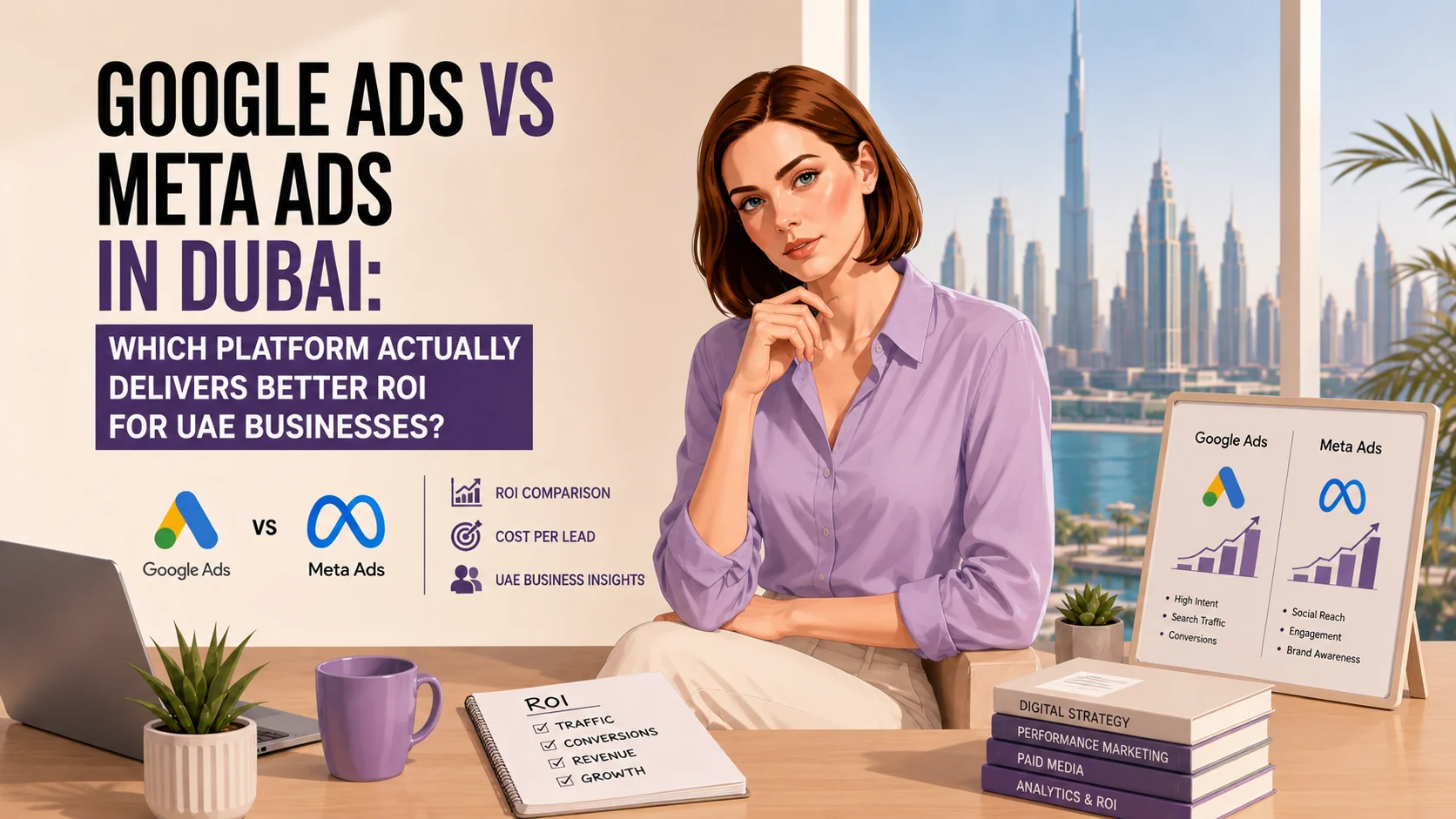
Every Dubai business running paid advertising eventually faces the same question: Google Ads or Meta Ads? Run both and the budget gets split thin. Pick one and you might be on the wrong platform entirely.
Most guides answer this question with "it depends" — and then list factors without giving a clear verdict. This guide gives you the clear verdict, by business type, with real AED numbers, because that's the answer that's actually useful.
The honest starting point: Google and Meta are fundamentally different machines. They don't compete for the same job. Understanding what each one actually does — and where it breaks down — is what makes the comparison useful.
"Google captures demand that already exists. Meta creates demand that didn't exist yet. Most businesses need both eventually — but most businesses should start with the one that matches where their buyers are in the journey."
The core difference: intent vs discovery
Someone searching 'Dubai business setup consultant' on Google has already decided they need a business setup consultant. They're looking for the right one. The job of the Google Ad is to appear at the right moment and make the click happen. The intent is there — the ad just needs to capture it.
Someone scrolling Instagram in Dubai who sees an ad for a business setup consultant was not thinking about business setup 30 seconds ago. They were looking at holiday photos, restaurant recommendations, or someone's story. The job of the Meta Ad is to interrupt that scroll and create interest that didn't previously exist. The intent isn't there — the ad has to generate it.
That structural difference has consequences for every metric you care about: cost per click, conversion rate, lead quality, sales cycle length, and the kind of creative that works on each platform.
Google Ads in the UAE: what you pay and what you get
Google Ads in the UAE typically runs on Search campaigns (ads shown when someone searches a relevant term), Performance Max (automated cross-channel campaigns), and occasionally Display (banner ads on websites across the Google network). For most B2B service businesses and high-intent service categories, Search is where the results come from.
Cost per click in the UAE is higher than the global average across almost every category — UAE ad costs reflect the high purchasing power of the market and the volume of competition from well-funded businesses.
| Industry | Google Ads CPC (AED) | Why |
|---|---|---|
| Real estate and property | 20–65 | Most competitive category in UAE paid search — developers and brokers with very large budgets |
| Legal and professional services | 18–55 | High-value clients (corporate law, auditing, visa services) justify high CPCs |
| Healthcare and clinics | 12–40 | Varies by specialty; cosmetic procedures and fertility clinics at the higher end |
| Financial services | 15–45 | Wealth management, insurance, mortgage — high transaction value |
| B2B services | 8–25 | Marketing, IT, HR, consulting |
| Home services | 5–15 | Renovation, cleaning, maintenance |
| Retail and e-commerce | 1–8 | Shopping campaigns — lower CPC but also lower margin per conversion |
The critical number that makes sense of these costs is conversion rate. Google Search campaigns in the UAE, when well-managed with strong landing pages, typically convert at 3–5% for service businesses. At a 4% conversion rate and AED 20 average CPC, you need 25 clicks to get one lead — a cost per lead of AED 500. At AED 8/click for B2B services, the same math gives a CPL of AED 200.
What you get from Google is highly qualified leads at the point of decision. The person is actively looking. They convert faster, need less nurturing, and often have a clearer buying brief. The trade-off is cost: Google Search is expensive in the UAE, and the volume of available searches limits how much you can scale.
Meta Ads in the UAE: what you pay and what you get
Meta Ads covers Facebook, Instagram, and the Audience Network. In the UAE, Instagram is the dominant creative surface — where the design quality, aspirational positioning, and visual storytelling of an ad matter enormously. Facebook tends to perform better for older demographics (35+) and more detailed text-heavy formats. Reels are growing in importance across both platforms.
The cost structure on Meta is fundamentally different from Google. You're paying for impressions first (CPM — cost per thousand views), and clicks and conversions come from those impressions. Typical Meta Ads benchmarks in the UAE:
- CPM (cost per 1,000 impressions): AED 15–55, varies heavily by audience targeting precision, ad format, and placement
- Average CPC (cost per click): AED 2–10 for most categories — significantly cheaper than Google Search
- Average conversion rate to lead form or website action: 0.5–2% — substantially lower than Google Search because the audience has lower initial intent
- Click-to-WhatsApp conversion to conversation: typically higher than landing page conversion for service businesses, as discussed separately
- Cost per lead via Meta Lead Ads (instant forms): AED 40–150 for most UAE service categories when campaigns are well-optimised
What you get from Meta is volume and awareness at lower cost per click — but lower quality at the top of the funnel. Meta leads often need more nurturing before they're ready to move. The sales cycle is typically longer. The buyer is at an earlier stage than a Google Search lead.
The strength of Meta is scale and audience targeting. Google Search is limited by how many people are searching for your service right now. Meta can reach anyone who fits your target profile — age, interests, job title, behaviours, location — regardless of whether they're currently in a buying mindset. For building brand awareness, reaching cold audiences, and nurturing people over time, Meta is where it happens.
Side-by-side comparison by UAE industry
The right platform depends heavily on what kind of business you're running, what the sales cycle looks like, and what margin the business works on. Here's the verdict by sector:
Real estate and property development
Both platforms, in that order. Google Search captures buyers who are actively comparing properties or looking for a specific type (off-plan villa in Dubai Hills, studio apartment in JVC). These leads convert faster and have a clearer brief. Meta is essential for awareness campaigns — reaching investors in the UK, India, or Russia who haven't started searching yet but match the profile of a typical UAE property buyer. Many developers run Meta for brand and Google for leads simultaneously.
Healthcare and clinics
Google first for most specialties. When someone is searching for 'IVF clinic Dubai' or 'cosmetic dentist Jumeirah', they're ready to book or at least enquire. The intent is high. Meta can support awareness for elective procedures (aesthetic treatments, wellness, preventive health) where discovery is part of the journey, but the lead quality from Meta for clinical services tends to be lower. Recommendation: 70% Google, 30% Meta for most UAE healthcare businesses.
Professional services (legal, finance, consulting, marketing)
Google dominant. Business owners searching for a specific service (business setup, VAT registration, accounting software, marketing agency) are in decision mode. Meta can work for brand awareness and retargeting — reaching people who've visited the website but not converted — but as a primary lead source, Meta tends to produce lower-intent leads for B2B professional services. The exception is LinkedIn advertising (which sits outside this comparison), which can outperform both for very specific B2B targeting.
E-commerce and retail
Meta dominant for most product categories. Visual discovery on Instagram is how many UAE consumers find new brands and products. Google Shopping works well when people are searching for a specific product, but for lifestyle, fashion, beauty, and home categories, the purchase journey often starts with a Meta scroll. Recommendation: 60–70% Meta for brand discovery and product sales, 30–40% Google for branded searches and bottom-of-funnel capture.
Restaurants, hospitality, and lifestyle
Meta with strong creative. People don't search 'best brunch Dubai' on Google before deciding where to go — they see something beautiful on Instagram and think 'I want to go there'. The visual nature of food and hospitality content makes Meta the natural home. Google may support location-based searches ('restaurants near me' on Google Maps), but the primary discovery mechanism is Meta/Instagram.
Education and training
Both, depending on the programme. Short-term professional development courses and certification programmes often start with a Google Search (the buyer knows what they want). Degree programmes, international schools, and new course launches benefit from Meta awareness campaigns to reach people who aren't yet searching but fit the demographic profile. Recommendation: Test both with equal budgets initially, then double down on whichever produces lower CPL after 30 days.
The decision framework: how to choose for your business right now
If you're working with a limited budget and need to pick one platform to start, these questions will give you the answer:
- Do people actively search for your service on Google right now? If yes — and you can verify this with Google Keyword Planner — start with Google Search. If search volume for your core service keywords is under 500 searches/month in the UAE, Google will be expensive and slow
- Is your product or service discovered visually? If people need to see it to want it (food, fashion, interior design, events), Meta is the right primary channel
- Is your average transaction value above AED 5,000? If yes, the higher CPCs on Google are easier to justify because a single conversion covers the ad cost many times over. Below AED 2,000 per transaction, Google CPCs can make the maths very difficult
- Do you have compelling visual content? Meta requires strong creative — static images, short videos, Reels. If you don't have it, Meta campaigns will underperform regardless of targeting
- Are you trying to build a brand or generate leads right now? Brand building belongs on Meta. Immediate lead generation belongs on Google. If you need results in 30 days, Google almost always delivers faster
"Budget threshold rule: if your monthly ad budget is under AED 5,000, pick one platform and go deep rather than splitting across two. At AED 5,000–15,000, you can run meaningful tests on both. Above AED 15,000, running both as a coordinated full-funnel system becomes the standard approach."
Running both platforms as a full-funnel system
The businesses that achieve the lowest cost per qualified lead over time are almost always running both platforms in a coordinated way — not independently, but as connected parts of the same system.
The full-funnel logic works like this: Meta creates awareness and builds the audience. Google captures the demand that awareness creates. Then retargeting on both platforms closes the people who engaged but didn't convert.
In practice for a Dubai B2B service business:
- Meta top-of-funnel: brand awareness campaign reaching your ideal client profile (job title, industry, location) with educational or problem-aware content — articles, short videos, thought leadership
- Google Search mid-funnel: captures people who saw your Meta ads and then searched your brand name or service category — branded search conversion rates are typically 15–30%, far above cold keyword searches
- Meta retargeting: reaches people who visited your website or watched your videos but didn't convert — a warm audience that already knows who you are, with a more direct offer
- Google remarketing: display ads shown to previous website visitors across the Google Display Network, keeping the brand visible during the consideration period
- Click-to-WhatsApp on Meta: used for high-intent bottom-of-funnel audiences, where the goal is to start a direct conversation rather than drive to a landing page
This kind of integrated approach typically reduces cost per qualified lead by 30–50% compared to running either platform in isolation, because each touchpoint is working with the audience at the right moment in the journey rather than trying to do everything in one ad.
Common mistakes that make both platforms underperform in the UAE
Understanding the platform difference matters, but execution failures are what actually kill most paid campaigns in the UAE market. These are the most common ones across both platforms:
- Sending all traffic to the homepage: the homepage is not a landing page. It has too many options, too much information, and no single focused CTA. Every paid campaign needs a dedicated landing page matched to the ad's specific promise
- Targeting too broadly to save money: broad targeting on Meta produces cheap clicks from people who will never buy. The budget looks efficient but the leads are weak. Narrow, precise targeting costs more per click but dramatically less per qualified lead
- Running the same ad creative for more than 3–4 weeks: UAE audiences are highly exposed to digital advertising. Creative fatigue sets in fast. Refresh ad creative at minimum every 3–4 weeks or frequency will rise and performance will fall
- Not tracking beyond the click: knowing how many people clicked the ad is not useful on its own. You need to track what those people did on the website, how many became leads, and how many leads became clients. Without this, you can't optimise
- Treating Google and Meta as interchangeable: they're not. A Meta ad that works on Instagram will not work as a Google Display ad. A Google Search ad that converts well tells you nothing about what messaging will resonate on Meta. Each platform needs creative designed for how people actually use it
Many of these execution failures are the reason campaigns that should work don't. Our guide on why paid ads fail in Dubai covers the most common root causes in detail — it's worth reading alongside this comparison before deciding which platform to prioritise.
The verdict
Google Ads is the right starting point for: businesses where people actively search for the service by name or category, high-ticket B2B services, healthcare and professional services, and any situation where you need qualified leads in the next 30–60 days and can't wait for an audience to be warmed up.
Meta Ads is the right starting point for: visual products and lifestyle services, businesses building a brand in a new market, e-commerce, any service that relies on discovery rather than search, and situations where the budget is moderate and the goal is sustainable volume over time.
Both platforms, run together as a coordinated funnel, consistently outperform either platform alone — but only when the creative, landing pages, and tracking are set up correctly. Platform choice is often the last factor. The quality of execution is what determines whether any of it actually works.
Not sure which platform is right for your UAE business?
247 Agency runs paid media on both Google and Meta for UAE businesses. We'll review your current setup, your goals, and your market, and tell you exactly where to start and what to expect.
Get a free paid media reviewAuthor
Valeriia Yahnenko
CEO & Co-Founder, 247 Agency
Valeriia Yahnenko is the co-founder and CEO of 247 Agency, a full-service digital marketing agency based in Dubai. She works with businesses across the UAE and Europe on brand positioning, paid media, social media strategy, website development and Google Ads — building systems that generate measurable reach, leads and sales rather than isolated campaigns.
LinkedIn Profile →Frequently Asked Questions
Which is cheaper — Google Ads or Meta Ads in the UAE?
Meta Ads are cheaper per click in the UAE — typically AED 2–10 per click versus AED 8–65 on Google Search depending on the industry. However, cheaper clicks don't mean cheaper leads. Google Search reaches people who are actively searching for your service, so they convert at higher rates (3–5% typically). Meta reaches a broader, less intent-driven audience, converting at 0.5–2%. For many service businesses, the cost per qualified lead ends up similar between platforms once conversion rates are factored in.
Should I run Google Ads or Facebook/Instagram Ads first for a new UAE business?
For most UAE service businesses launching with a limited budget, Google Search comes first — because it captures people who are already looking for what you offer. The lead quality is higher and the sales cycle is shorter. Start Meta when you have a baseline from Google, a clearer idea of your customer profile, and strong visual creative to run. Exception: if your business is visual (food, fashion, lifestyle, beauty) or relies on discovery rather than search, start with Meta.
What is a realistic cost per lead from Google Ads in Dubai?
For well-managed Google Search campaigns in Dubai, cost per lead typically falls in these ranges: B2B professional services AED 150–400, healthcare and clinics AED 100–300, real estate AED 400–1,500 (high due to very high CPCs), home services AED 80–200, e-commerce varies by product. These figures assume well-built landing pages and campaigns that have been optimised for at least 30 days. Brand-new campaigns with no optimisation history will often have higher initial CPLs that improve over time.
Can I run Google Ads and Meta Ads at the same time on a small budget?
At budgets below AED 5,000/month total, splitting across two platforms usually means neither gets enough spend to optimise properly. The algorithmic learning phases for both Google and Meta require a minimum level of conversion data to work effectively — typically 30–50 conversions per month per campaign. Below that threshold, you're flying blind. At under AED 5,000/month, pick one platform, run it properly, prove the model, then add the second platform when the budget allows.
How long before Google Ads or Meta Ads start producing consistent results in the UAE?
Google Ads campaigns typically show initial results within 2–4 weeks but need 60–90 days of optimisation before cost per lead stabilises. Meta campaigns usually need 2–6 weeks for the algorithm's learning phase to complete — during which performance can be erratic. For both platforms, the first month should be treated as a data collection phase rather than a revenue-generating phase. Setting expectations correctly from the start prevents premature campaign shutdowns before the data is meaningful.