Digital Marketing Agency Pricing in 2026: What Businesses Should Actually Pay
Digital marketing agency pricing in 2026 can range from a few thousand dollars per month to large multi-channel retainers. The real question is not what is cheapest. It is what level of pricing is enough to produce useful commercial outcomes.
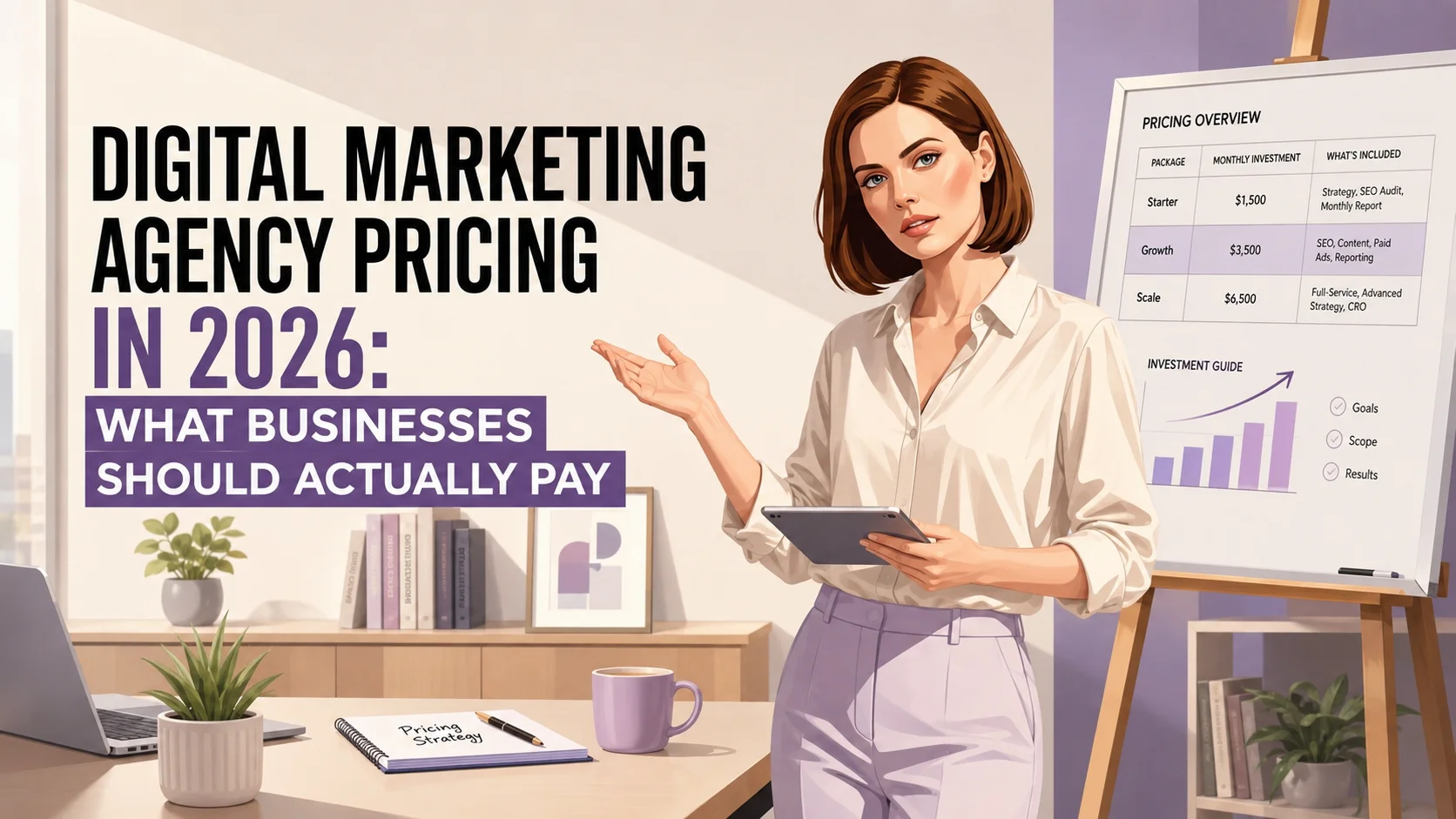
Digital marketing agency pricing in 2026 is one of the most misunderstood topics in the industry.
One proposal says an agency can manage your marketing for a few thousand dollars per month. Another says you need a five-figure monthly retainer. A specialist quotes a project fee. A performance agency suggests a hybrid model. A freelancer offers something cheaper than all of them.
It is easy to assume someone is overcharging, someone else is undercharging, and the whole market is inconsistent.
"The real reason pricing feels chaotic is that businesses are often comparing completely different levels of work under the same label of digital marketing."
Quick answer
There is no single correct digital marketing agency price in 2026. But there is a practical rule:
If you need only one narrow service, a smaller monthly fee or project price may be enough. If you need strategy, content, paid media, landing pages, conversion thinking, reporting, and actual commercial accountability, the real cost will be meaningfully higher.
- Low-cost support often buys execution tasks.
- Mid-range pricing often buys one or two properly managed channels.
- Serious retainers usually buy a connected growth system, not just deliverables.
Why agency pricing varies so much
A lot of businesses make the same mistake before they even start comparing proposals: they compare price before comparing scope.
That is dangerous because two agencies can both say digital marketing while meaning completely different things. One may be talking about social posting and a monthly report. Another may be talking about strategy, paid media, landing pages, analytics, content, CRO, and account-level decision-making.
Those are not interchangeable services, so they should not be expected to cost the same.
The biggest pricing differences usually come from these variables:
- How many channels need active management
- How much strategy is required
- Whether the website or landing pages need work too
- How much content or creative production is involved
- How competitive the market is
- How complex the tracking and reporting needs are
- Whether the agency is expected to help drive pipeline, not just activity
- How senior the team working on the account is
The five most common pricing models in 2026
1. Monthly retainer
This is still the most common model for ongoing agency work. The client pays a fixed monthly fee for an agreed scope. That scope can range from one channel to a broader growth program.
Retainers work well when the business needs continuity, optimization, and regular strategic attention rather than a one-off burst of work.
2. Project-based pricing
This works best when the deliverable is finite: a website, a positioning sprint, a campaign launch package, a content system, or an audit. It is useful when the business has a clear start and finish to the work.
The risk is that many businesses buy a project when what they actually need is ongoing iteration.
3. Performance or commission model
This sounds attractive because risk appears lower at first. But performance-based agency pricing often gets messy fast. Attribution is harder than people expect. Lead quality varies. Sales teams affect outcomes. Channel limits exist.
A lot of businesses imagine performance pricing removes risk. In reality, it often shifts the argument to what counts as a result.
4. Hybrid pricing
This combines a base retainer with performance upside, project fees, or media-related bonuses. It can work well when both sides want ongoing commitment with some shared incentive.
5. Hourly or consulting-based pricing
This usually fits audits, advisory work, training, diagnostics, or senior-level strategic support. It is less useful when the business expects full execution across multiple moving parts.
What businesses should actually expect to pay
The ranges below are not universal laws. They are broad commercial expectations for 2026 and should be treated as framing, not fixed quotes.
Starter support: roughly $1,500-$4,000 per month
This usually covers a narrow scope: perhaps one smaller channel, limited SEO support, simple social management, or light operational work. It can be useful for maintenance, but rarely supports a true growth system.
Businesses often get disappointed here when they expect strategy, creative, testing, content, CRO, and reporting depth at the same time.
Focused growth management: roughly $4,000-$8,000 per month
This is where a business can usually start managing one or two channels more seriously. It may support paid search, paid social, SEO, or content with better planning and accountability.
This range becomes weak if the brand message, website, and conversion path all need work too.
Connected growth system: roughly $8,000-$20,000+ per month
This is the range where agencies can often support strategy, media, landing pages, content, analytics, and conversion improvement together. For many serious service businesses, B2B companies, premium local brands, and multi-market businesses, this is where outcomes start to look more commercially coherent.
Enterprise or multi-market programs: $20,000+ per month
At this level, the business usually expects larger team involvement, more production, more channels, more reporting complexity, tighter alignment with internal stakeholders, and faster execution.
"The right budget is not the one that sounds easiest to approve. It is the one that gives the work enough room to succeed."
What a serious agency fee should include
A serious agency fee should cover more than output volume. It should support the work needed to improve business performance, not just keep marketing activity moving.
- Strategy and channel planning
- Audience and offer analysis
- Creative direction or content planning
- Campaign setup and optimization
- Landing page or website input where needed
- Tracking, reporting, and interpretation
- Regular decision-making support
If a proposal gives you a long list of deliverables but no commercial logic behind them, the pricing discussion is already off track.
Agency fee vs ad spend vs production budget
One of the biggest points of confusion in digital marketing pricing is that businesses mix different budget categories together.
Agency fee pays for thinking, planning, execution, optimization, communication, reporting, and strategic management. Ad spend goes to platforms. Production budget covers assets, design systems, video, photography, copy, or landing-page development when required.
If a company says it has a $10,000 monthly budget, that does not automatically mean the agency fee should be $10,000. The real split depends on what needs to be built and what needs to be bought.
- Agency fee: management and strategic work
- Ad spend: money paid to Google, Meta, LinkedIn, TikTok, or other platforms
- Production: creative assets, content, landing pages, and technical support
Cheap agency pricing: when it is fine and when it becomes expensive
Cheap agency pricing is not automatically bad. It can make sense when the task is narrow, the business already has a strong website, the offer is clear, and the scope is maintenance-heavy.
It becomes dangerous when the business expects the agency to fix growth problems without paying for the strategic and operational depth required to do that.
This is where low pricing often becomes very expensive. The business does not lose money because the invoice was high. It loses money because months pass with weak offers, weak pages, weak testing, weak reporting, and weak conclusions.
- Cheap support can be fine for maintenance.
- Cheap support is risky for serious growth goals.
- Underpriced marketing often hides under-scoped thinking.
What different kinds of businesses should budget for
Local service business
A local service business usually needs search demand capture, trust signals, service pages, reviews, maybe local SEO, and selective paid campaigns. It does not always need every channel, but it does need clarity and conversion.
B2B company
B2B companies often need longer-cycle content, stronger positioning, landing pages, proof, and a tighter connection between marketing and sales. A low retainer tends to break down quickly if the work includes pipeline responsibility.
Ecommerce brand
Ecommerce usually requires a mix of creative production, paid media, analytics, product-page optimization, email or retention work, and faster testing cadence. The business should separate management cost from media spend and content production.
High-ticket or premium service business
In high-ticket categories, one qualified lead can justify stronger monthly investment. That means pricing should be judged against the value of a converted client, not just against the desire for a low retainer.
New brand or startup
A startup often needs sharper positioning and controlled testing more than broad channel expansion. The smartest budget is usually not the one that does everything. It is the one that reduces uncertainty fastest.
Red flags when comparing agency pricing
A strong proposal should make you feel clearer, not more dazzled. Be careful with agencies that:
- Use the same package for every business
- Talk only about outputs and never about business outcomes
- Never review the website or landing pages before quoting
- Do not ask about margins, lead quality, or sales process
- Promise fast growth without diagnosing the funnel first
- Confuse ad spend with agency fee
- Hide weak scope behind buzzwords
Pricing should reflect thought. If the proposal process shows no real thinking, the delivery probably will not either.
If you are also comparing providers, read how to choose a digital marketing agency and our guide to top digital marketing agencies for a better evaluation framework.
What businesses should actually pay
The honest answer is this: businesses should pay enough for the work to be commercially competent.
If the business needs only a narrow operational service, it should not overpay for a full growth agency. But if the business needs strategy, lead generation, conversion support, stronger messaging, and cross-channel performance, it should not expect bargain pricing to produce serious outcomes.
A good price is not the lowest number. It is the price that matches the commercial complexity of the job.
Need a realistic view of agency pricing before you commit?
247 Agency helps businesses understand whether they need light support, focused channel management, or a broader growth system so pricing decisions are tied to actual goals, not guesswork.
Talk to 247 AgencyFinal takeaway
Digital marketing agency pricing in 2026 only feels confusing when businesses compare numbers without comparing the work behind them.
Once you look at scope, strategy, execution depth, conversion responsibility, and business complexity, pricing becomes easier to judge.
The real question is not what should marketing cost in theory. The real question is what level of pricing gives your business a real chance to win.
Author
Valeriia Yahnenko
CEO & Co-Founder, 247 Agency
Valeriia Yahnenko is the co-founder and CEO of 247 Agency, a full-service digital marketing agency based in Dubai. She works with businesses across the UAE and Europe on brand positioning, paid media, social media strategy, website development and Google Ads — building systems that generate measurable reach, leads and sales rather than isolated campaigns.
LinkedIn Profile →Frequently Asked Questions
How much does a digital marketing agency cost in 2026?
It depends on scope, market complexity, and how much strategic and execution depth the work requires. A narrow service can cost far less than a full multi-channel growth retainer.
What is a typical digital marketing retainer?
Typical retainers vary widely, but many businesses can expect lighter support in the low thousands per month, more serious one- or two-channel management in the mid-range, and connected multi-channel growth retainers at substantially higher levels.
Should I choose retainer pricing or performance pricing?
Retainers usually work better when ongoing optimization and strategic continuity matter. Performance pricing can work in some models, but it often creates attribution and quality disputes if the definition of success is not clear.
Why are some agencies so much cheaper than others?
Usually because the scope, seniority, strategic depth, production level, and accountability are very different. A cheaper agency may be offering narrower execution, while a more expensive one may be supporting a broader commercial system.
What should be included in a serious agency fee?
A serious fee should usually include strategic thinking, campaign management, reporting, optimization, communication, and whatever channel or website support is required to move the business toward better outcomes, not just more activity.