Brand Identity vs Logo Design: What's the Real Difference (and Which Do You Need)
"Just send me a logo" and "we need a brand identity" sound similar in a brief, but they are different jobs with different price tags and different outcomes. Here's how to tell them apart before you brief anyone.
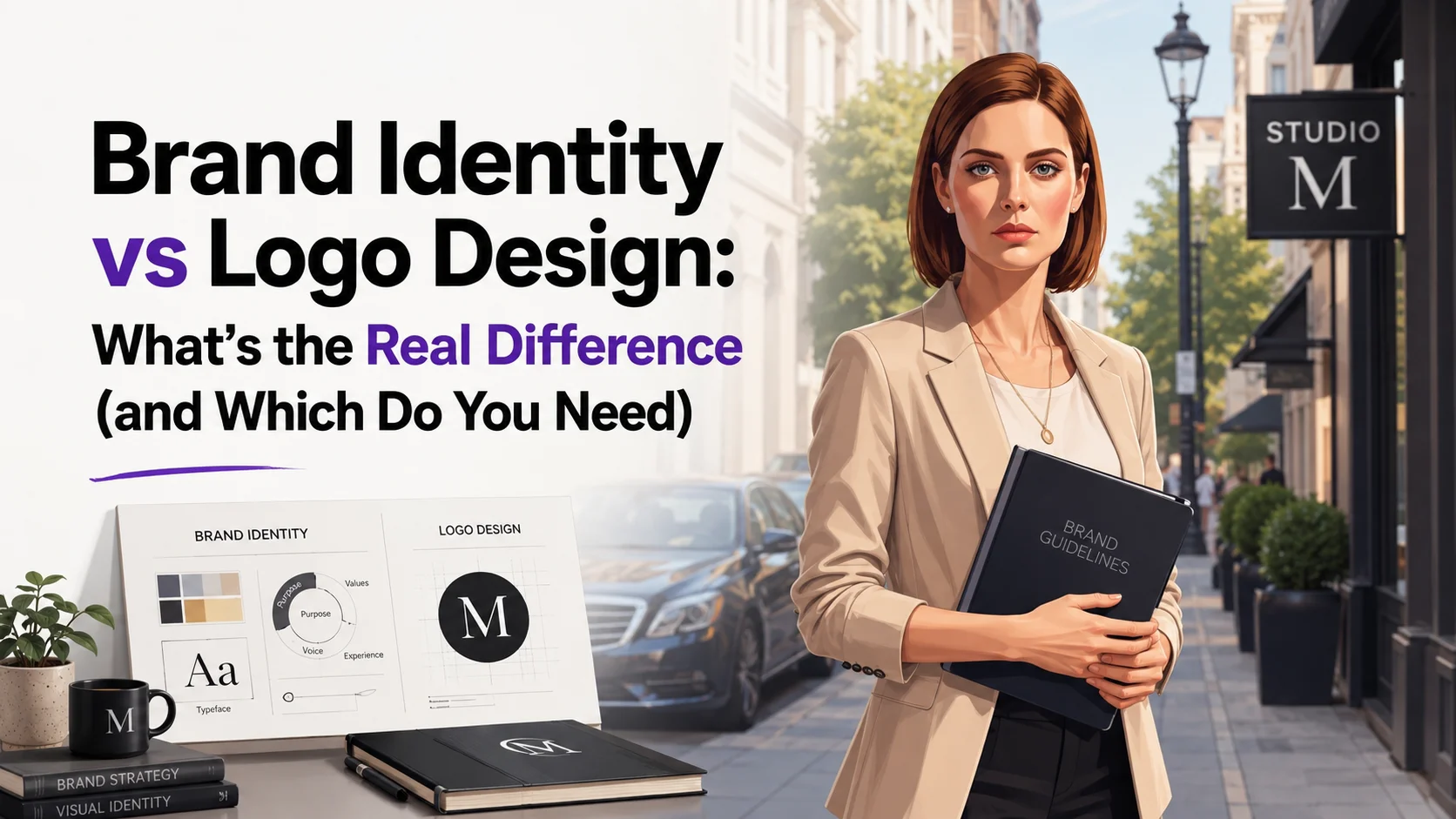
"Just send me a logo" and "we need to build our brand identity" sound like two versions of the same request. They are not.
One is a focused design task with a clear deliverable. The other is a broader system that the logo eventually has to live inside. Mixing the two up is the most common reason businesses end up either overpaying for scope they don't need yet, or underbuying and having to redo the work within a year.
Here is the difference in plain terms — what each one actually is, how they relate to each other, and a practical way to work out which one fits where your business is right now.
What is logo design?
Logo design is the process of creating the mark that represents a business — the symbol, wordmark or combination of the two that people learn to recognize. A logo design package typically produces the primary logo plus the variations needed to use it correctly: a horizontal and vertical lockup, a monochrome version, an icon or favicon, and basic usage examples.
Logo design answers one question well: what does the mark look like, and how can it be used correctly across the basics? It does not, on its own, answer how the brand should sound, which colors belong together beyond the logo itself, or how the brand should look on a slide deck, a storefront or a campaign banner.
What is brand identity?
Brand identity is the complete visual and verbal system a business uses to look and sound the same everywhere it appears — the logo plus the color palette, typography, imagery direction, tone of voice, usage guidelines and real application examples across the channels the business actually uses.
Where a logo answers "what is the mark," a brand identity answers a longer list of questions: which fonts belong on a proposal versus a social post, how the brand should sound in a caption versus a contract, what the color system looks like on a dark background, and how all of it scales onto a billboard, an app icon or a printed box without falling apart.
"A logo is one asset. A brand identity is the system that tells you — and everyone who works on the brand after you — exactly how to use that asset, and everything around it, correctly and consistently."
Brand identity vs logo design — the practical differences
- Scope: a logo package delivers a mark and its variations; a brand identity package delivers the mark plus a full visual and verbal system around it
- Output: a logo gives you files; a brand identity gives you files plus a guide for how to use them correctly across every situation
- Lifespan: a logo can stay stable for years; a brand identity can adapt — new templates, new applications, new markets — without the core system breaking
- Cost logic: logo pricing is driven mainly by the design work itself; brand identity pricing is driven by the breadth of the system and how many touchpoints it needs to cover
- Who needs it first: a new business with a narrow, simple presence may only need a logo right now; a business expanding across channels, team members or markets usually needs the fuller system sooner rather than later
How they connect — one feeds the other
Logo design and brand identity are not competitors — they are stages of the same work. The logo is usually the most visible piece of the identity system, but it works best when it is designed inside a clear strategic direction rather than ahead of one.
A logo designed before the brand's positioning is clear can still look polished. The risk is that it ends up saying very little, because the visual decisions were made without a clear answer to who the brand is for and why it should be chosen. A logo designed as part of a wider identity process tends to be easier to extend later — into templates, social systems, signage and campaign assets — because the thinking behind it was never narrow to begin with.
That's also why positioning sits at the start of the process rather than the end. If you want the fuller picture of what a complete system looks like once positioning is in place, our guide to what's included in a brand identity package breaks down each component and what tends to get left out of thinner proposals.
Which one does your business actually need right now?
There is no universally correct answer — only a correct answer for the stage the business is at. A few situations make the choice clearer:
Choose a focused logo package if…
The business is early-stage, the presence is still narrow (a website, one or two social profiles), and the priority is having something usable and consistent to launch with — without overcommitting before the positioning and audience are fully clear.
Choose a full brand identity package if…
The business is showing up across multiple channels already, more than one person is producing brand materials, the look feels inconsistent from one platform to the next, or the business is preparing to expand — into new markets, new product lines or a larger team — and needs a system that can scale without being rebuilt from scratch each time.
A useful rule of thumb: the more places the brand has to show up, and the more people involved in producing those materials, the sooner a full identity system pays for itself by removing guesswork.
How 247 Agency approaches both
247 Agency structures branding work in four scoped tiers — Logo, Branding Base, Branding Pro and Branding Premium — so a business can start with exactly the scope it needs now, and move up as the brand grows rather than starting over.
- Logo — a focused package for a clean logo system: primary logo, lockups, monochrome version, icon, wordmark, type choice and usage examples
- Branding Base — adds the core identity structure: font system, color palette with codes, and everyday brand application examples
- Branding Pro — expands into rollout assets: landing page direction, brand pattern, social templates, stationery and avatar assets
- Branding Premium — a deeper system for brands scaling into campaigns and digital products: graphic elements, presentation kits, source templates and a landing page foundation
Every project starts the same way regardless of tier — with the strategy stage, where positioning gets defined before any visual decision is made. You can see the full process and package breakdown on the branding services page.
Not sure whether you need a logo or a full identity system?
247 Agency reviews where your brand actually is right now — not just what's in the brief — and recommends the scope that fits your stage, audience and growth plans.
Book a branding callFinal takeaway
A logo is a mark. A brand identity is the system that makes that mark — and everything around it — work consistently, everywhere the business shows up. Neither one is automatically the "better" choice; the right one depends on how many places your brand needs to appear today, and how fast it's likely to need to appear in more of them tomorrow.
Get that scope decision right at the start, and the rest of the branding conversation — including the budget conversation — gets a great deal easier.
Author
Valeriia Yahnenko
CEO & Co-Founder, 247 Agency
Valeriia Yahnenko is the co-founder and CEO of 247 Agency, a full-service digital marketing agency based in Dubai. She works with businesses across the UAE and Europe on brand positioning, paid media, social media strategy, website development and Google Ads — building systems that generate measurable reach, leads and sales rather than isolated campaigns.
LinkedIn Profile →Frequently Asked Questions
Is brand identity the same as logo design?
No. Logo design produces the mark and its core variations. Brand identity is the broader system around that mark — color palette, typography, imagery direction, tone of voice, usage guidelines and real application examples — built so the brand looks and sounds consistent across every channel it uses.
Do I need a full brand identity if I'm just starting out?
Not always immediately. Many early-stage businesses start with a focused logo package and expand into a full identity system once their presence grows across more channels and more people are producing brand materials. The goal is choosing a starting point that won't need an expensive rebuild soon after.
Why does a logo designed without a brand strategy often fall short?
A logo designed before positioning is clear can still look polished, but it tends to say very little about who the brand is for and why it should be chosen. A logo designed as part of a wider identity process is generally easier to extend later into templates, social systems and campaign assets, because the thinking behind it was never narrow to begin with.
Which costs more — a logo package or a full brand identity package?
A full brand identity package typically costs more than a standalone logo package because it covers a wider system — color, type, imagery, voice, guidelines and application examples — rather than the mark alone. The right comparison is not the price tag on its own, but the price relative to how much of that system the business actually needs right now.
Can a logo package be upgraded into a full identity package later?
Yes, when it's planned for. Choosing a package built with some flexibility in the logo system and color logic makes it easier to expand into a fuller identity system later without redesigning the core mark from scratch.